The Chair Leaves the Chair: Pete Stone Signs Off
Written By: Prinitha Govender | Creative Director at Skripture
Every role eventually comes with a different kind of interview. Not the one that gets you in, but the one that reflects on what it asked of you.
The Fremantle Biennale has always been a festival shaped by currents – tidal, cultural and emotional. After eight years at the helm, the Biennale’s chair, Pete Stone, steps away from the role, leaving behind a legacy defined not by spectacle, but by conviction: that art belongs to place and place belongs to people. Widely regarded as a pillar of Fremantle’s art community, Pete Stone’s departure marks the end of formative era that has shaped not only the Biennale’s identity, but the city’s evolving cultural soul.
As the organisation prepares for its next chapter, I sat down with Pete Stone in late 2025 for our inaugural Job Interview feature – an intimate, lightly irreverent conversation that looks back at the role he stepped into, the unexpected moments that shaped it and the future he now passes on.
What does it take to chair an event that is as experimental as it is deeply local? And what does stepping away really feel like when your fingerprints are woven throughout its foundations? This is Pete Stone’s exit interview.
Do you remember the moment you agreed to become Chairman? What convinced you?
I think Tom Mùller and Corine van Hall discussed it first amongst themselves and they both approached me together. It didn’t take much convincing – I thought it was great opportunity for me to be honest (laughs). But also, I was already well ensconced in the world of the Biennale. I was already on the board – the board started in 2018 and I was in the chairman position in 2019, but I’ve been involved from the first iteration in 2017. From the outset, when Tom first came to me with the idea, to the City of Fremantle, to talk about it, I was convinced of the brilliance of the idea so it wasn’t a hard decision for me and I’ve enjoyed every minute of it.
If this role really were a job you were interviewing for today, how would you describe it in one sentence?
I’d describe it as a really good job (laughs). We made a conscious decision as a board, when we started, that our job wasn’t to be the artistic directors. Obviously, as we were a really small organisation, we’re across all that and involved in those conversations, which is a very fun part of the work, but we clearly saw our role as facilitating Tom and the team to do the great things that they can do and not telling them what to do. And we stuck to that and I think that it paid off and it created a very friendly sense of camaraderie between the board and the staff and hopefully they felt supported during process. I know that I can speak on behalf of the board and say that all the board members have really enjoyed being part of the board because of the closeness of the organisation – I feel that we understood what our role was and that we were comfortable doing that.

Who were you when you first took on the role eight years ago and who are you now, figuratively speaking, of course?
So in that period, since I first met Tom and was introduced to the Biennale, I’ve done a few different roles in my professional life – I was manager at Fremantle Arts Centre at that time and then I had stint at Perth Festival, which I really enjoyed. I also had a few years at the City of Melville running their arts program and now I’m back at the City of Fremantle in a director role – so I’m the same person, but I’ve learnt a lot. I’ve had a lot more experience and I guess doing jobs that I don’t necessarily know a lot about before I’ve done them. So, I’ve evolved and learnt a lot in the last eight years and the Biennale has been a big part of that. I think a fundamental change is that I’ve definitely learnt to work with people. I mean, I’ve always worked with people but I feel like I’m better at that now and identifying what I’m bringing to the table, but more importantly, what I’m not bringing to the table and so working with other people who can bring other things that I can’t bring and recognising when people have particular skillset that I don’t have and hopefully trying to make the most of that.
Was there a defining moment earlier in your life that shaped how you show up as a leader today?
I’ve had an ad hoc working life, as in, I didn’t wake up one day with clear career aspirations or any kind of particular career plan in mind – it has been quite organic. So, I’ve just followed opportunities as they’ve come. But, I’ve had two or three really great bosses, particularly in my really early years of working, who taught me a lot, through either directly or through osmosis, and that was all about honesty, integrity and if you’ve made a mistake, put your hand up and say you’ve made a mistake and let’s see how we can work together to work it out and not pretend like you know everything. Also, to understand that a leader is only as good as the team. You learn that if you’re in a leadership role, you can never be the expert on everything because that just doesn’t happen and so once you open yourself up to the idea, that you’re not, and that you’re happy to work with people who know a lot more than you do and that it’s not a threat – it’s a joy – then, it actually becomes fun.
What daily rituals or personal habits have kept you grounded over the last eight years?
I walk the dog most mornings and do a little exercise which is a good way to start the day. A little bit of running as well – I find that clears my head a bit. I also find, I often solve problems unknowingly, when I’m doing that sort of activity, or something I’ve been pondering that I haven’t worked out – suddenly it hits me after a long walk or a bit of running. Apart from that, I guess I’m like everybody else, you know, work gets stressful and you have times that are difficult, so in that, I think it’s important to remember to take the time to celebrate the good things, which I know is a cliche. But actually that can be hard to do if you’re very busy and things just keep rolling on but that’s a really important thing to do. I look back over my working life now and you don’t remember – you know there’s thousands of meeting and thousands of issues, but you don’t really remember all that stuff – you just remember a handful of significant things that you’re personally proud of, basically, and you take that with you. And also, understanding who you are – I think sometimes we get new jobs and we think, “I’ve got to be this sort of person in this job”, but that’s actually not true. Generally, people have employed you because they want you, right? So, I think it took me a while to learn that – playing to your strengths and a big part of playing to your strengths is understanding your weaknesses – that’s also what keeps me grounded.
Which Biennale, as Chair, are you most proud of?
Well, that a really good question – all of them (smiles), but, particularly this last one. I said to Tom afterwards, that I feel like SANCTUARY was really embedded in the community and I made the comment to Tom that: “It’s not your festival anymore. It belongs to the community” and I meant that in a very positive way. It really felt like the local community, but the wider community outside of Fremantle as well, embraced it this time in a way that I haven’t really felt before. I’ve felt it in moments and in pieces previously, but I felt that the whole festival was really embraced by the community and that came through the whole three weeks of SANCTUARY. I thought that was a significant achievement, so for that reason, I’m saying the last one was my favourite.
What was it about SANCTUARY, do you think, that led to it being embraced so well by the community as compared with previous years?
I think it started with the theme “sanctuary” and that theme resonated, it really did, and it flowed through everything. The community hub down at Manjaree was a central point; we’ve had hubs before but I thought this one in particular worked very well. But also, it was a slightly different approach in the programming this year than in previous years. Previously, there’s been the big hero event, like Waterlicht, the Arcs d’Éllipses down on High Street or the drones presentations (First Lights), whereas this year, there was just more concentration on the quality and the density of the programming across the board and I felt that really helped the community connection. Also, I felt this time when you were wandering around the Biennale, it was really easy to engage with all the works and on a self guided tour in a way that was a development on previous biennales.
Is there a memory from your time as Chair that always makes you smile?
There’s lots. I do have a memory (laughs) of the first biennale and the Éllipses work that ran all the way down High Street – the artist with a huge ladder on his one shoulder, paint in the other hand, cycling the wrong way down the street – and thinking, Oh here we go, we’re off on this big adventure! I wasn’t quite sure how it was going to unfold, but you know, it unfolded beautifully. But I think the memory of the last one will stay with me and how much it was embedded in the community and how, as we’ve talked about before, how it really felt like the festival crossed a bridge in this last iteration, from being a festival owned by the Fremantle Biennale to a festival that’s now owned by the community, and that was a significant moment for me to feel that.
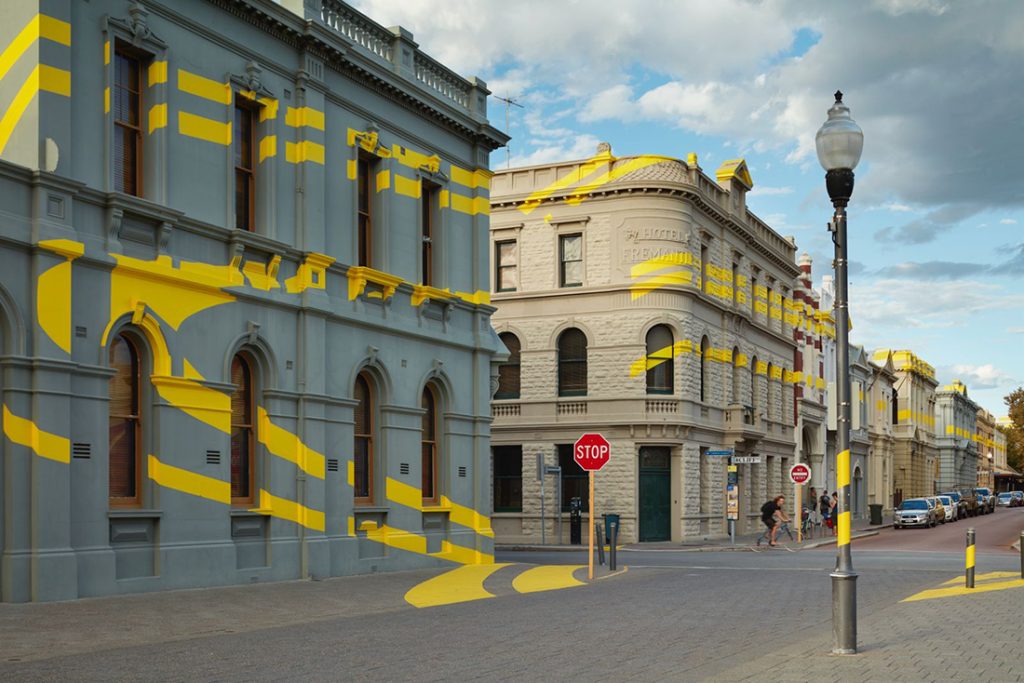 Felice Varini, Arcs d’Éllipses (2019)
When you look back over the last eight years, what’s an achievement with the Fremantle Biennale that still gives you a quiet sense of pride?
It really is the development of the organisation, so aside from the actual presentations of the Biennale and all the great work that goes on there, it’s the fact that as a group, as a board and a staff group together, we’ve managed to evolve. You know, what is still a small organisation, into an organisation that has a few different streams of business and presentations now and some security for the staff and a future that looks open rather than: We’re going to do the same thing for the next 20 years. We’ve always talked very openly about – I think it’s really important to keep asking yourself, What’s the point of it? Often a lot of arts organisations can drift on essentially delivering the same thing for a long time and eventually I think that loses momentum.
I don’t think all arts organisations are designed to be there forever and most of them aren’t, and you know, we talked openly about – Should this be here for 10 years and then call it quits and say that was that, and we’re happy and everybody moves onto something else? – and that has been a serious conversation. But, whilst we’ve been having those conversations, the Biennale has diversified into other areas, like First Lights and other program opportunities that are now taking up a fair bit of time and focus. So, that’s what I’m most proud of – that development of the organisation into something that I did not envisage at the start of my involvement. It’s just something that happened along the way – we’ve embraced the opportunities that have come and when we started, we didn’t envisage we’d have such a broad colour palette of projects beyond the actual Biennale.
What do you see as the core purpose of the Fremantle Biennale and how has that evolved during your time as Chairman?
I still believe, as I did from the outset, that the core legacy of the Biennale is bringing art to the people – so out of the gallery spaces and into the world and reducing the barriers of interaction for everybody and I think the Biennale has been successful at that. I guess the intricacy with that is the cleverness behind the program. It is an accessible program and there’s often no barriers to it, like – it’s often free or it might not be in an elite gallery space where not everybody is comfortable going, it might just be out in the open public area. But, I think the cleverness in the programming that the team have done is they’ve managed to do that but then provide this real depth to the programming every time, which allows you, without pressure, to explore deeper into the Biennale program as you’re comfortable, as you want to. It’s easy to engage in initially, and then as you’re comfortable, people can move in deeper and deeper into it and that the audience member kind of feels in control as opposed to having something presented to them – I think basically, that’s been it’s strength.
What was the hardest part of the job as Chair that no one sees from the outside?
There’s an element of risk management. Small organisations often run on the smell of a oily rag and whilst funding develops, you have to have an appetite for the acceptance of risk, obviously within reason, but, there is no progress without risk. Risk comes in many forms – it can be the risk about the programming – is it going to work, is it going to land, is it going to resonate? It can be the fundamental risk of audience management and the safety of presentations. It’s not like working in a large organisation that’s heavily funded and has all sorts of resources – so it’s a fine line between risk mitigation and acceptable risk. That’s probably the thing that I’ve thought most about in the quiet times, that’s not necessarily public.
How has the Fremantle arts ecosystem evolved over the past decade, and how do you think the Fremantle Biennale has contributed to that?
Despite gentrification in Fremantle, it has still managed to maintain an eclectic, creative industry and that hasn’t diminished – that has evolved over the last decade, for sure.There’s still traditional organisations, but also lots of groups of people or community groups that get together and do things in a space that aren’t necessarily incorporated organisations or anything, so there’s been a lot of that deep DIY activity over the last decade, which personally, I really love – it makes a great contribution. I think the Fremantle Biennale has contributed over the last 10 years by positioning itself a little differently to everything else. They’ve really focused on the idea of collaboration and that has manifested in opportunities for great artists living and working here to meet and work with great artists coming into the Biennale from wherever that may be in the world. I think people talk about that a bit, but I think the Biennale has really lived and breathed that and so there’s many connections that still exist from previous biennales between great artists living and working here and artists that have come from around the world to participate in the Biennale. I think that’s a legacy and that was a way the Biennale positioned itself to hopefully, contribute to the developed creative practice in WA – and that’s going to produce stuff in the future that we’re not even aware of.
What made you feel like now was the right moment to pass on the baton?
For many reasons. Because I’ve been involved in five biennales, four of them as chair, I’m a great believer in not hanging on for too long in these positions, regardless of how it’s going. I think evolution in these key positions is really important to the longevity and the momentum of the organisation – so that feels right. We also have an amazing board and Ella McNeil who is stepping up as chair, is an excellent candidate for the position. Also, with Tom Mùller stepping down as artistic director of the Biennale, that also feel like it aligns – time for some fresh faces with both the chair role and the artistic director role – with Tom obviously staying on in the organisation as CEO. So, that all feels right. And yea, it’s time for someone else to have the opportunity and also it’s nice to – and it wasn’t planned this way as you never know how things are going to go – it feels right leaving after this one because of what I said before about it really feeling like the community sort of owns the festival now rather than us, so that feels like a nice time to hand over the baton.
You mentioned earlier about Tom Mùller concluding as Artistic Director of the Fremantle Biennale. How would you reflect on your time working alongside Tom all these years on this incredible journey?
Unique is the word I would use to describe that. Tom has an incredibly creative brain and also a very astute business brain. It’s an unusual combination; it’s often one or the other. His attention to detail in terms of budgeting for the festivals and that level of detail is extreme. He’s very easy to work with in that way as you always feel like you’re aware of what’s happening and there’s no great surprises popping up and there’s no big holes in the budget popping up, so that makes it incredibly easy to work alongside him. And that sits alongside his unique ambition – you know, he’s an ambitious person in the programming realm. He takes risks and he gets out there and forms relationships and I look back now over the years and look at the relationships he’s formed with people around particular presentations in the Biennale and that’s a lot of work, and he’s exceptional at it. It’s been great to be alongside him while he’s doing it and to witness that. And I’ve always loved to go to meetings with Tom (smiles) – he talks so articulately about the program in general and whatever the particular things are that we’re discussing at that meeting and we sort of understand our roles in that situation – I’m representing the governance element as the chair, but people love to hear Tom talk about the program and that’s been a joy.
What are you excited to reclaim in your life now – forgoing the time, dedication and commitment you had as Chair – where will you direct that focus?
It’s not been onerous – it’s never felt that way. I’m just being honest and I’m not being a martyr or playing it down. It’s just mostly been a joy. There’s not other things in my life that I’m desperate to get to because I’m not doing the Biennale. It’s just, as we discussed – it just feels like the right time. I’ll still be around and I’ll still be going to them all and I just look forward to seeing it evolve into what’s next – and who knows what that will be.
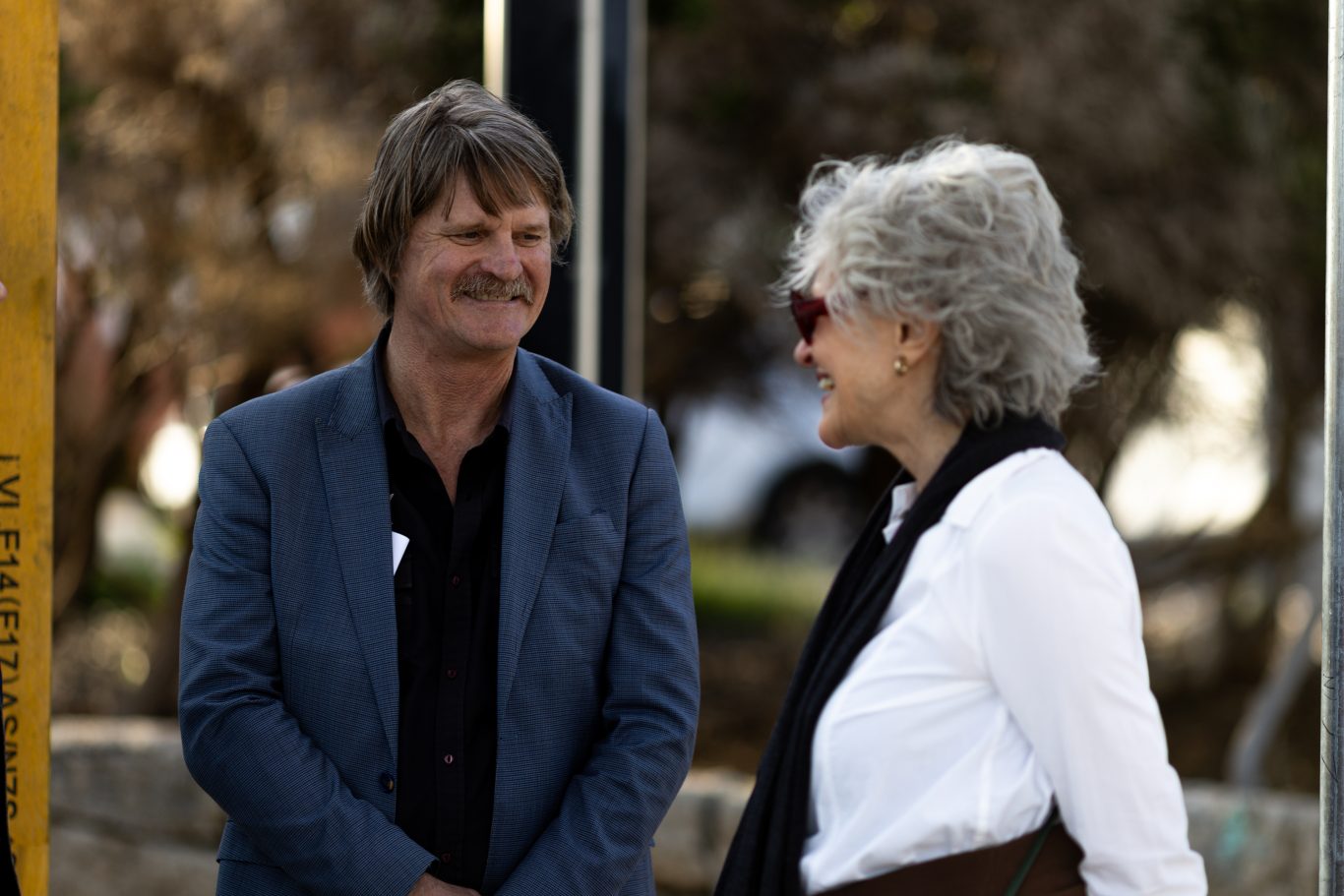
 Fremantle Biennale SANCTUARY 25 Opening (2025) | From left: Pete Stone, Simone McGurk | Image Credit: Duncan Wright
This feature was created for Fremantle Biennale by Skripture.