Written by: Prinitha Govender | Creative Director at Skripture
Mary Hill moves through the art world with steady grace, with an eye for nuance, a generosity of vision and a lasting influence on the Fremantle Biennale and Western Australia’s cultural landscape.
There’s a quiet moment just before Mary Hill begins to speak when you sense the depth of her life – a life shaped by a series of crossings: between countries, languages, cultures and the ever-shifting territories of art. From her childhood in Yorkshire to the sun-creased streets of Fremantle, Mary has carried a quiet curiosity and an instinctive pull toward creativity. She has been a linguist, a traveller, a collector, a companion to artists and a constant observer of the subtle ways art illuminates everyday life.
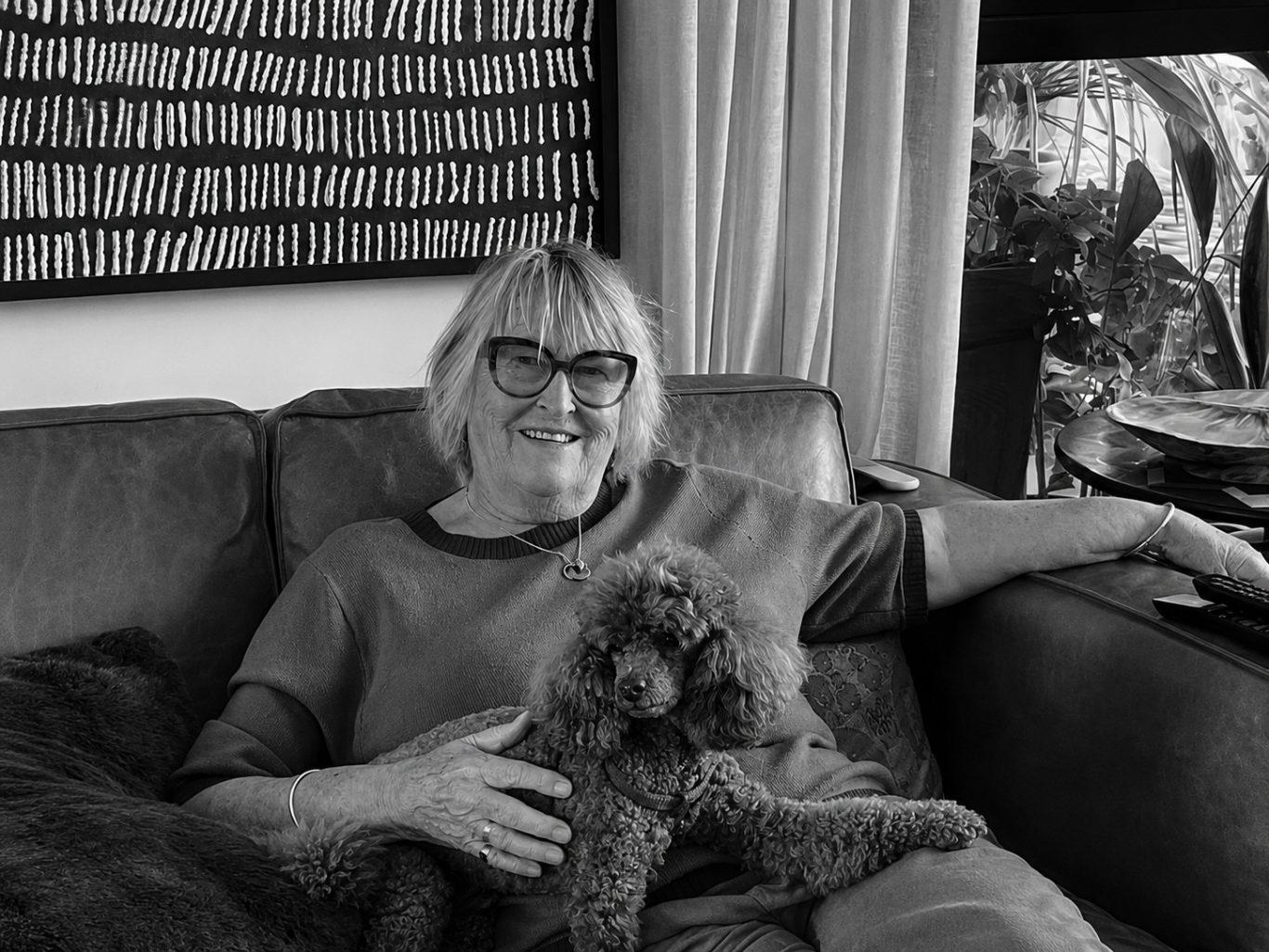
Today, Mary is known as a generous supporter of the arts, but spend a moment with her and another portrait emerges: a woman who is deeply attuned to people, to stories and to the ways art binds communities together. Her journey, like the city she loves, is one of boldness, warmth and continual transformation. As I sit with her in her new home overlooking the ocean, Mary’s devotion to the creative world feels quietly tangible. A Balinese artwork hangs in her living room, its presence simple yet profound. “It just makes me feel happy when I look at it,” she says. Fremantle has been her anchor for decades, and in return, she has helped shape its cultural landscape with a presence both understated and enduring. This is Mary Hill’s story – not only as a benefactor of the Fremantle Biennale, but as a woman whose life reveals why art matters.
Mary traces her first, formative encounters with art back to her early life with her (now late) husband, Christopher Hill, at his home in Somerset, England – a house she says was filled with objects chosen for their beauty, history and presence, and very different from the strict Methodist home she grew up in. Some of those pieces travelled with them when they moved to Australia, and as she gestures around the living room, they appear less like possessions than companions. “The three-hundred-year-old carpet here, the black wedgwood pot, the Portuguese bowl,” she says, “they’re all things that came from that house that we brought with us when we came to Australia.”
Their life with art deepened after relocating to Fremantle in 1986, where they found themselves living next door to Magda and Douglas Sheerer, the owners of Galerie Düsseldorf. What began as a neighbourly connection unfolded into an education of sorts – late-night dinners, conversations with artists and a gradual immersion into the rhythms of the art world. Over time, they began saving deliberately, piece by piece, evolving from attentive observers into committed art collectors.
Mary Hill’s story, however, stretches back further still. She arrived in Yorkshire at age seven, the youngest of four sisters, already two years ahead of her peers at school. Her path through education was unconventional: eschewing elite expectations, she chose Bristol University over Oxford or Cambridge, a decision emblematic of her independent spirit. “My father had been to Cambridge University and in Britain, if you go to Oxford or Cambridge it’s meant to be elite, but I refused to do that because I didn’t want to go to Oxford or Cambridge because I’d never been interested in elitism, so I applied to Bristol University and I was accepted a year earlier, which was again quite unusual.” So, to fill in the time, Mary lived in Germany for a year as an au pair with a family. That year spent living in Germany honed her linguistic skills and nurtured a love of cross- cultural exchange, a sensibility that would later infuse both her personal and professional life.
After her immersive year in Germany and subsequent studies at Bristol University, Mary’s path crossed with Christopher Hill, the man who would become a central part of her life. Despite their very different backgrounds, they hit it off immediately when they met at university. They later married and soon after decided to make a fresh start together in Australia. “Chris had no career prospects in Britain (coming from a landed gentry background), and so we decided we would leave Britain,” Mary recalls. “At that time, in 1968 you could look around the world and Australia was offering ten pounds to stay for two years – you had to give up your passport for two years. So it seemed like the logical thing to do.”
It was in Western Australia that Chris flourished, developing a deep engagement with the arts as a scholar, curator and advocate, particularly through his work with Western Australian and Balinese artists. Immersed in this growing cultural world, Mary’s own defining love of languages continued to shape her path: she became head of language programs at Methodist Ladies College, teaching French and German, and later pursued Indonesian studies at Murdoch University. Together, their intellectual and creative lives became increasingly intertwined – grounded in curiosity and cultural exchange.
It was this lifelong immersion in language, art and culture, shaped through teaching, travel and a shared intellectual life that would later draw Mary, almost by chance, into the world of the Fremantle Biennale.“I went to an art talk by Felici Varini and he spoke in French. There was a translator and he quite frankly wasn’t very good. At one stage he misspoke and Tom Mùller and I just looked at each other across the room and rolled our eyes – that was a lovely connection,” she recalls. From that shared glance grew a deeper involvement, as Mary began supporting the Biennale through grants and advocacy, seeing it as a way to honour her late husband who had a love for Fremantle and a love for art. “Yes, in a way,” she says when I asked if her involvement was a tribute. “Since he died, I’ve donated hundreds of pieces of art and it’s always been in Chris’s name, always. I kept some Balinese art, Aboriginal art and Western Australian conceptual art there are always three strands to the collection.”
That initial encounter also captured what Mary values most about the Biennale itself. She is particularly drawn to its immersive, site-responsive approach – art that speaks directly to place and invites the viewer into an active exchange. “Because it’s people expressing themselves to the world and you, as an observer, you’ re able to take on what could benefit you and create your own world from that art,” she says. She points to two of her favourite works: Felici Varini’s Arcs d’Éllipses piece on High Street in 2017 and the light installation, Waterlicht, on the Esplanade. “These are places you’re very used to in everyday life and suddenly they’re completely transformed. I think site-responsive art is brilliant – it’s a good thing. It’s powerful, yes.” For Mary, this is where art truly matters: in its ability to reframe the familiar, invite personal interpretation and deepen the relationship between people, place and creativity.
When asked which spaces in Fremantle hold personal meaning for her, Mary reflects on the recent biennale, SANCTUARY. “I think, especially this last Biennale, the Whale Tunnel below the Round House was particularly well done. The Round House and Whale Tunnel are parts of Fremantle I’ve always liked, and although we often overlook how it began, as a prison for Aboriginal people, I find it very difficult, as an incomer, to come to terms with some attitudes in Australia toward Aboriginal history.” Through this lens, she sees art not only as transformative but also as a way to engage with the layered histories of place, making the familiar both new and meaningful.
Mary also reflects on how her migrant experience shapes her engagement with the city and the Fremantle Biennale. “I supported Raki Nikahetiya’s work (Fifty Thousand Years, Or For As Long As We Remember) at the last biennale and that was interesting because he interviewed me about being a migrant and I think that is such a big part – people don’t realise how it affects my everyday life because I know how I met everybody – I have no school friends here, I have no university friends – I know how I’ve met people and I find in the the various groups I’m in, there’s always a slight disconcerting when they talk about people they’ve known forever and I don’t know them and I have started saying – Sorry excuse me, I don’t know who you’re talking about – because people forget that if you’re a migrant your life starts new and there’s a line there.”
When asked about inspiration, Mary resists the idea of singular figures or artistic heroes. Instead, her values come into focus. “I don’t feel any one person inspires me,” she says. “I feel very strongly about social justice, equality and fair play,” she explains. “I get very angry if I think things aren’t fair for somebody. Social justice and that kind of thing is really important to me.” Her convictions were sharpened early. She speaks candidly of rebelling against her father’s strict Methodist values and of a lifelong resistance to elitism. “I grew up always achieving what I did through myself, through my intelligence,” she reflects. Scholarships, opportunities, even her year as an au pair in Germany came not through inherited advantage but through initiative. “I took my own initiative. I’ve never wanted to be part of a norm. I’ve always wanted to be an individual.”
These beliefs found collective expression in the feminist movement of the 1970s, a period that continues to inform her outlook today. “It just appals me how, fifty years later, how backward things are going,” she says. “Strong women, and women collectively, who know what they want and go for what they want and have the courage to do that, inspires me.” It’s a philosophy that echoes throughout her life – principled, independent and quietly defiant of convention.
When asked what might most surprise her younger self, Mary laughs and gestures toward her present circumstances. “Living in a million-dollar apartment at the beach,” she says, amused, “in a very bland area.” Fremantle, she admits, remains her spiritual home, a place that aligns more closely with her inner compass. Still, she approaches this new chapter with characteristic openness. “I’ve been here for two months, I like the people I’ve met here and my life is easy here,” she reflects. “I’m going to give it some time.” Still, there is a sense of adjustment as she misses her prior home in South Fremantle. “I miss the garden, I miss hanging my washing out, I miss the quirkiness of my house. Also, it’s the third house I’ve worked on with an architect to design my home and I’ve always been able to reach my kitchen cupboards and I come in here and can’t even reach half the cupboards (laughs). So I’ve curated this into my space but haven’t created this as my space, as I have with my previous homes.”
For Mary, these distinctions matter. Home, like art, is not simply about surface or status – it’s about authorship, intention and lived experience. This sensibility, shaped by independence, fairness and a resistance to hierarchy, underpins her enduring relationship with artists, with Fremantle and with the Fremantle Biennale itself. Mary Hill’s influence in the arts extends beyond the works she collects or the exhibitions she supports. It lives in the opportunities she creates, the artists she has stood beside and the conversations she helps bring into being. Through a discerning eye and a quiet, unwavering generosity, she has nurtured practices that might otherwise have struggled to find space. In doing so, she has helped shape not just collections, but communities.
Her ongoing contribution to the Fremantle Biennale and to Western Australian arts more broadly, is a reminder that art is sustained not only through creation, but through care: through those who pay attention, who commit and who believe in its capacity to transform how we see the world. It is in this steady, considered way that Mary’s legacy continues to unfold, not loudly, but enduringly, enriching the cultural landscape with thoughtfulness, generosity and a belief in art’s capacity to quietly reshape how we live with one another.
The Quiet Force of Mary Hill
19 May 2026
19 May 2026